

THE KITCHEN WORKBENCH & ERGONOMICS
“The way it looks on your chopping board, that’s how it looks in your head.” (Stevan Paul)
In more than 5 years of working with the kitchen workbench, we have hardly encountered any concerns as often as the question of ergonomics:
How does it feel with this array of containers between you and the actual cutting board, and don’t you get the worst back pain within minutes of bending over while standing there?
Since Johannes always took the board with him to work in the restaurant kitchen to test it from the very beginning, the answer was always off the top of our heads: "No, not at all," because even after a tough 16-hour shift there was no more back pain than usual.
Nevertheless, we believe the question is justified, so we have worked on the topic theoretically to have a solid answer ready whenever this question arises.
For this answer, we first examined the processes on a conventional cutting board.
We identified work zones, working directions, and problems.
Then we did the same with our board and compared the results.
The result is simple and quite plausible – here is our theory of work zones:
THE CUTTING BOARD & WORK ZONES


A) On a normal chopping board, right-handed people work fairly centered in the middle and store the food they are not working on to the left, while the cut food is more likely stored on the right side.
This is because you always hold the food with your left hand and push it to the right after cutting with the knife blade.
B) Somewhere on the board there is a collection point for a certain amount of waste, which is always emptied into a second, larger waste container, and a collection point for cuttings, which must be regularly transferred by hand into a suitable container off the cutting board.
Thus, there is a working direction running from left to right, while the working center is focused in the middle of the board.
Area A (the space between the chef and the work area) is almost completely unused because otherwise cuttings or waste would fall off the board.
The rear half of the workstation is divided into a working area, a storage area for cut material yet to be processed, processed cuttings, and waste. Salt, spices, and small ingredients are freely scattered on the worktop in alternating sections.
We are all aware of the problems that can arise with this setup:
Mixing of cuttings and waste due to no clear separation of storage zones,
a time-consuming and cumbersome hand transport to a pan or other container and a frequently overloaded work area.
THE NEW WAY OF COOKING: INTUITIVE STRUCTURE AND ORDER
The layout of the work zones on our board is quite different:
While the working zones basically remain the same, the way the zones are distributed in the available workspace changes fundamentally.


The chef is, of course, a little further away from the board, which causes the working area to shift to the previously unused area (A).
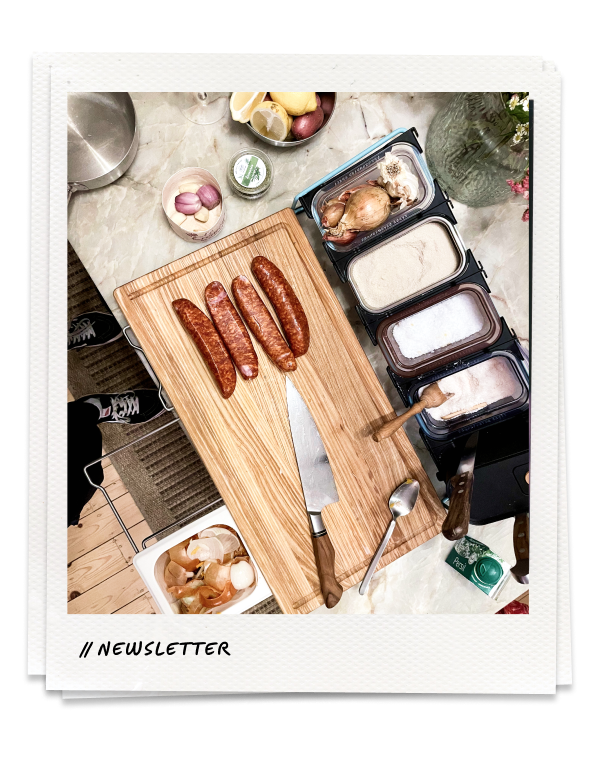
The cuttings (A) and waste (C) have dedicated zones at the front in the form of containers – the storage area (D) now extends over the entire rear half, followed by a fixed dedicated zone (E) for salt, spices & small ingredients in the display bracket.
BACK TO THE TOPIC - THE KITCHEN WORKBENCH & ERGONOMICS

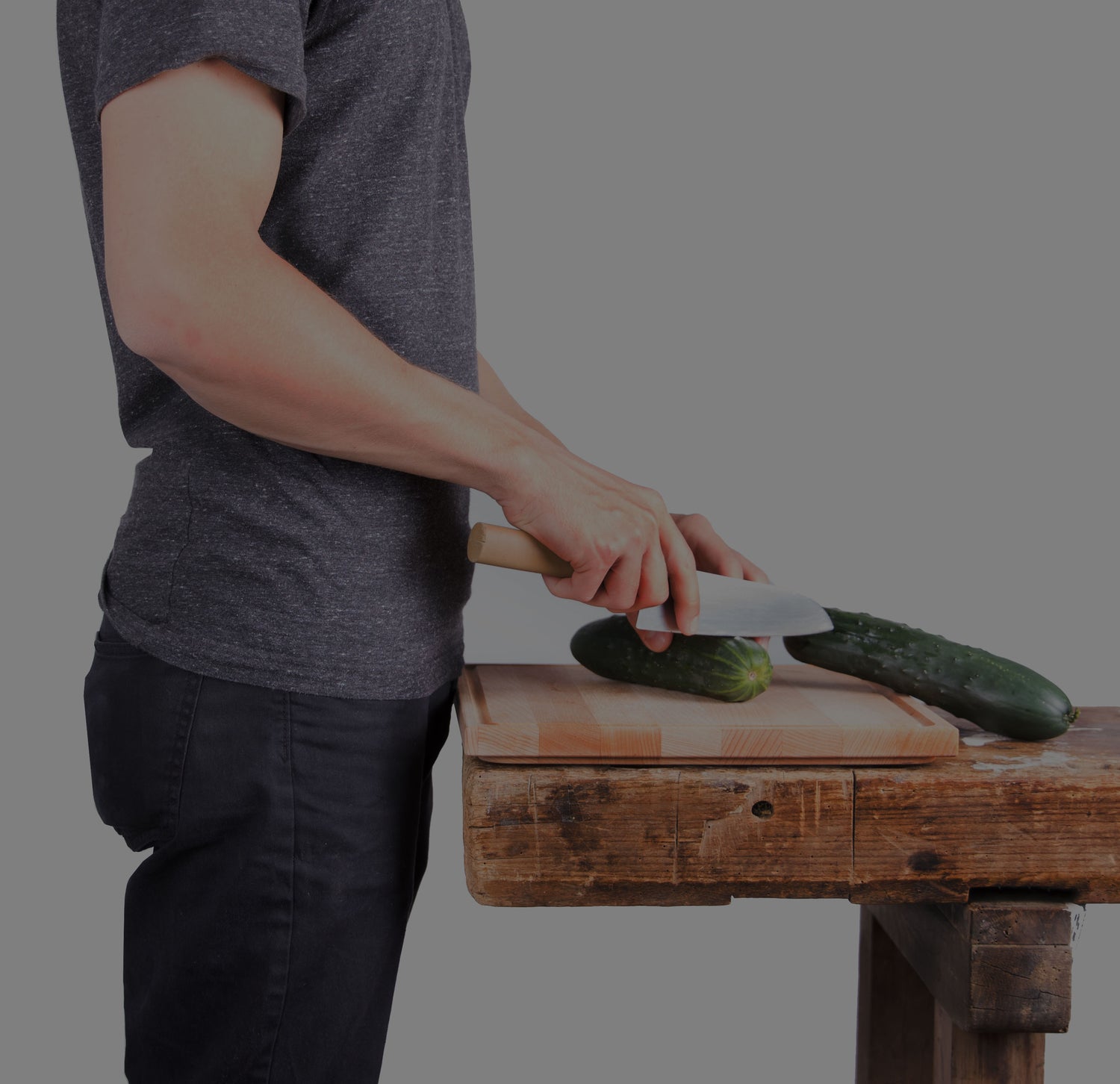
If you place both pictures exactly on top of each other, it becomes clear that the posture is completely identical and does not change at all when working with our board.
The real innovation in working with our board is the use of the previously unused zone (A) between the kitchen and the work area for storing waste & cuttings – an area that until now has probably remained largely unused due to its immediate proximity to the edge of the board (and thus the kitchen floor).
This reallocation of the work zones creates space – on the cutting board itself – by effectively balancing the usually fatally overlapping work zones.
And it ensures more tidiness – the resulting waste is immediately separated from the cut material and safely stored in its own container. The cut material is also handled the same way, so the work surface remains clean and tidy at all times, without any extra effort.
The container system blends almost imperceptibly into existing workflows and feels so natural in use that it is actually easier to integrate it into the work processes than not to use it.

FOOD - PREPARED WITH THE FRNKFRTR BRTT - TASTES BETTER!
This claim is, of course, somewhat bold and deliberately provocative – but in principle:
The less energy you have to spend on logistical processes, the more energy and love you can invest in the overall experience of "eating" – that is, tasting, serving, presenting, and the relaxed enjoyment of guests – which should lead to better results on the table & plates and memorable evenings.
So even if there is only 5% truth in this claim – can you expect more from a kitchen tool?